
The Irish labour market hasn’t slowed – it’s become sharper, more selective, and more strategic. The IrishJobs 2026 Hiring Trends Update, based on surveys of 502 employers and 987 workers, shows that hiring is still happening, but with greater selectivity and discipline. Employers are adapting to an active yet pressured environment, workers are staying open and skilling up, and both sides are recalibrating how they compete.
The story of 2026 can be told in three chapters – a reality check, a great adaptation, and early signs of resilience.
Chapter 1: The Reality Check
A more active market, but a tougher path to hire
Despite global uncertainty, the Irish job market remains active. 39% of employers increased hiring in the last six months (up from 33% in Autumn 2025), but current confidence in securing the right talent has dipped slightly to 6.6/10 (from 6.8). Hiring is more efficient – the median time to hire has fallen from 10 weeks to 8 weeks – yet more complex, with greater candidate openness adding to the administrative load.
Key takeaways:
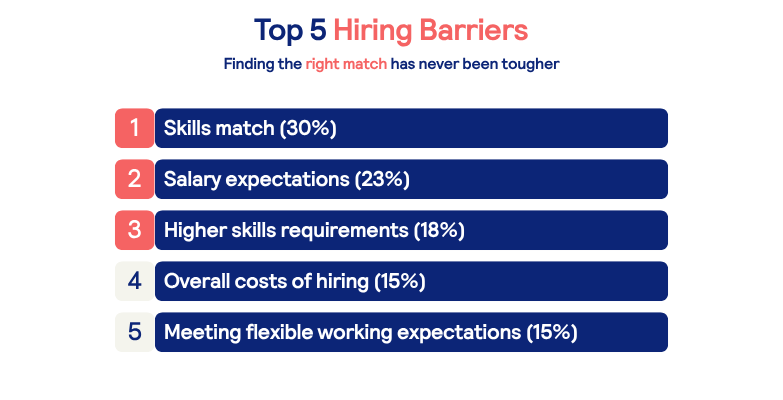
- Skills fit remains the #1 challenge, as employers say the real problem is not supply but alignment – of skills, expectations, and cost.
- Rising salary expectations are now the #2 hiring challenge, with 23% of employers struggling to meet candidate demands.
- The candidate experience is congested: 73% of workers say it’s harder to get an interview, and 65% don’t hear back beyond an autoreply. For every 10 applications submitted, workers report 6 rejections and only 2 interviews.
National Living Wage impact:
- 51% of employers cut Q2/Q3 headcount plans due to the NLW increase.
- 47% reduced entry-level roles specifically.
This isn’t a hiring freeze – it’s a reallocation of resources and attention to where talent impact is greater.
What matters now:
Speed is a competitive advantage, but quality still wins. Audit your hiring process, sharpen role briefs, and define must-have criteria to balance efficiency with accuracy.
Pay Transparency: From Policy to Strategy
The EU Pay Transparency Directive is raising expectations, both internally and in the talent market.
- 44% of Irish employers already have defined salary bands.
- 40% plan to introduce them this year.
- 30% expect added budgeting and workforce planning strain.
- 38% see transparency as a way to improve attraction and retention.
Pay discussions are becoming strategic. Clear salary structures and consistent messaging will soon be an employer brand baseline – not a nice-to-have.
Chapter 2: The Great Adaptation
TA leading the charge as both employer and workers reshape strategy
Irish employers are pursuing precision over volume. Talent Acquisition (TA) teams are moving from reactive hiring toward strategic workforce planning.
TA under pressure, but leading through it:
- 83% say TA has become more strategic
- 67% have broader HR or business responsibilities
- 64% describe workloads as “harder than ever.”
As hiring becomes more complex, TA is evolving into a decision-enabling function, not just a delivery engine.
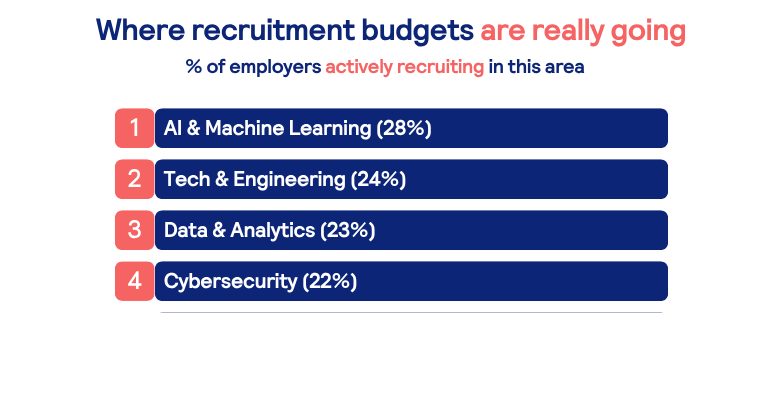
Where recruitment budgets are going:
Employers are focusing on specialist and capability-building roles rather than broad expansion.
Priority areas:
- AI & Machine Learning – 28%
- Sales & Business Development – 24%
- Tech & Engineering – 23%
- Cybersecurity – 22%
FOBO – Fear of Becoming Obsolete – is driving reskilling.
- 41% of workers worry their roles could become obsolete.
- 86% feel confident their skills will stay relevant over the next three years.
- 35% have learned AI tools in the past year.
- 85% would move industries if needed.
This shows a workforce shifting from job security to skills security – opportunity is growing for employers open to cross-sector talent.
Recruiters adapting to tech change:
- 49% worry about AI’s impact on their role.
- 78% already use automation or AI tools in hiring.
Adaptation is already happening from both sides of the hiring table.
Chapter 3: Resilience
Signs that hiring is moving – and who’s leading the way
Despite challenges, employers are showing discipline rather than retreat.
- 39% increased recruitment in the past six months, while only 9% expect a decrease in the next six.
- Hiring confidence sits at 6.6/10 overall, but large organisations (250+ report higher confidence at 54% expecting to increase hiring, compared to 35% of smaller firms.
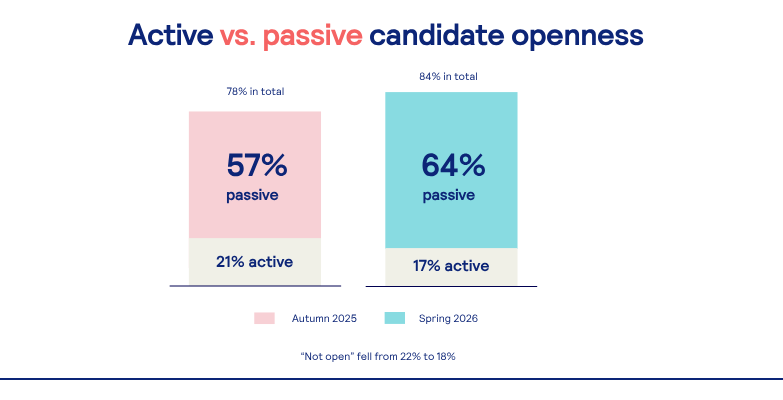
- 81% of workers are open to new offers (p from 78%), though 88% remain content in their current roles – evidence that openness is cautious, not desperate.
Employer takeaway: High openness doesn’t equal high movement. Conversion depends on credibility, clarity, and a friction-free process.
Pay transparency as a competitive advantage:
38% of employers believe the Directive will strengthen attraction and retention; 28% say it will improve hiring efficiency and workforce planning.
IrishJobs users outperform the market:
- 41% say hiring has become easier (vs 20% of non-users).
- Confidence is higher at 6.8/10, compared to 5.9/10 among non-users.
Prepared, data-driven employers are better placed to compete in a selective market.
The Expert View
“Despite a major energy shock and elevated geopolitical uncertainty, economic indicators show that the Irish economy is navigating these challenges well and continues to experience domestic growth. The Spring Economic Forecast recently published by the Government sets out a number of scenarios for the Irish economy over the coming months, depending on the depth and duration of the conflict in the Middle East. In all scenarios, the economy is expected to continue to grow, but at a slower pace, with inflation increasing. Unemployment is expected to remain under 5 per cent, backed by strong, though slowing, employment growth. The hiring outlook remains broadly positive with employers expected to face continuing high levels of competition for talent and strong upward pressure on wage growth.”
– Julius Probst, Senior Economist, The Stepstone Group
“Published today, the H1 2026 IrishJobs Hiring Trends Update provides a snapshot into the recruitment landscape in Ireland during a period of exceptional volatility and change. It’s clear from the findings that despite ongoing economic uncertainty, Ireland’s labour market remains fundamentally resilient. Employers are planning for growth, particularly in sectors such as manufacturing and construction, where demand for skilled talent continues to outpace supply.
At the same time, we’re seeing a clear shift toward more strategic hiring, with organisations prioritising business-critical roles that support productivity and long-term competitiveness.
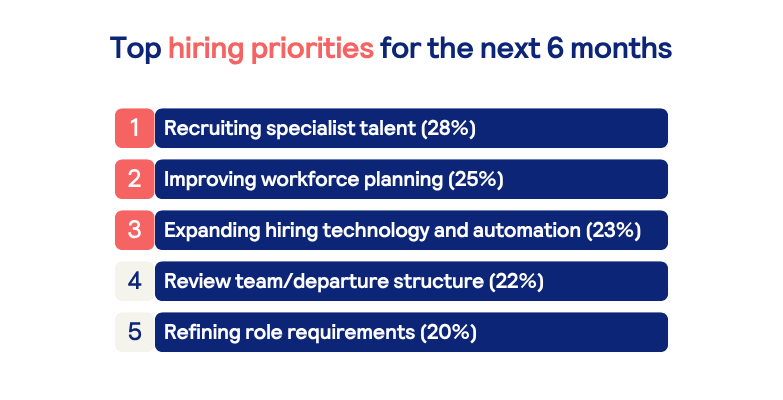
As hiring becomes more selective, our findings show that employers are prioritising targeted capability-building in specialised functions such as AI and cybersecurity, rather than broad-based expansion. Rising labour costs and advances in AI are also reshaping workforce planning, prompting many employers to rebalance their hiring mix and focus on experienced talent with in-demand skills.
For employers, success in the months ahead will depend on the ability to invest in talent development and adapt their hiring strategies to these shifts. More employers will likely take a skills-based approach to hiring, as they look beyond traditional qualifications to identify candidates with the technical and transferable skills needed to adapt in this fast-changing environment. Employers who take a proactive approach to talent planning today will be best positioned to navigate a shifting labour market and sustain growth in the months ahead.”
– Chris Paye, Country Director, The Stepstone Group (IrishJobs)
The Bottom Line
The Irish labour market is steady under pressure, not slowing down. Hiring is being reassigned, not reduced. The employers who thrive will be those who:
- Sharpen role definitions to ensure stronger skills alignment.
- Lead with stability, addressing salary, flexibility, and balance together.
- Keep candidate communication fast and clear – 65% of applicants never hear back.
- Widen their talent lens, considering adjacent industries and reskilled candidates.
- Act early, keeping hiring plans tied to long-term business priorities.