
Drawing from an analysis of 1.3 million advertised job positions in Ireland across 15 industries, IrishJobs’ latest research uncovers the crucial salary and benefits trends shaping recruitment in 2026.
In this article, we’re taking a closer look at the findings and what they mean for employers navigating the Irish labour market in 2026.
Key takeaways
* Pay remains the primary driver of job moves, with 51% of job switchers prioritising higher salaries and 44% of candidates planning to look for a new role in 2026.
* Despite 58% of workers receiving pay increases, 49% cut leisure spending and 27% cut essential spending.High-paying sectors lead on satisfaction, with technology, banking & finance and construction delivering the strongest salary and benefits sentiment.
* Flexibility is non-negotiable for many workers, with 41% ruling out roles that lack flexible working options.
* 72% of candidates avoid applying for roles that don’t include information around salary.
* The gender pay gap is narrowing but disparities persist across industries and in pay rise satisfaction.
Market updates: Economic conditions continue to shape pay and hiring
Hiring in Ireland remains active for 2026, but employers are proceeding with greater caution, while demand for skilled talent continues to shape pay decisions. Employers remain cautious, with many reporting that they scaled back plans to increase pay (27%), bonuses (25%), and benefit expressions (17%) in response to economic pressures.
The factors businesses reported as having a significant impact on their compensation decisions in the last 12 months include:
* Recruitment of highly sought-after skilled workers (61%)
* Inflation and rising cost of living (61%)
* Company performance/business results (59%)
These economic factors continues to dictate both employer and candidate salary decisions. Candidates are looking for higher salaries in 2025 while employers are increasing pay, particularly for skilled talent in industries such as construction, banking & finance and technology.
Salary trends across 2025
Our findings show that the advertised average gross median salary in 2025 for Ireland reached €54,928.
Dublin maintains its position at the top of the city rankings, with an advertised median salary of €60,000. Following behind, Galway presented an advertised median salary of €52,000 in 2025, with Cork’s advertised median salaries for the year at €46,200.
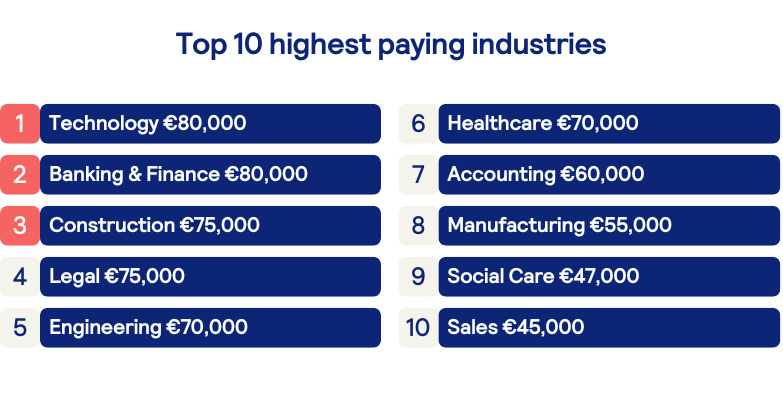
When it comes to individual industries, Technology and Banking & Finance offered the highest advertised salaries (€80,000), followed by Construction (€75,000), Legal (€75,000), and Healthcare (€70,000).
However, a different picture emerges when looking at salary growth. The fastest-growing industries in 2025 were:
* Manufacturing (38%)
* Healthcare (33%)
* Construction (25%)
These increases reflect a combination of skills shortages, regulatory complexity and commercial pressure. While Technology and Banking & Finance continue to command premium pay, the sharpest increases are being driven by sectors facing acute labour shortages and structural change.
In Manufacturing and Construction, competition for scarce technical and project expertise is intensifying, while Healthcare salaries are rising rapidly as providers respond to sustained workforce pressure and growing demand for specialised skills.
As in previous years, construction stands out as the only non-office-based sector among the highest-paying industries. Persistent labour shortages, an aging workforce and sustained infrastructure demand continue to push wages upward, making construction one of the most competitive industries for employers.
As a result, employers in these sectors are being forced to reassess renumeration strategies to attract and retain critical talent in an increasingly competitive market.
Salary satisfaction
Despite the rising cost of living, employee salary satisfaction was healthy in the past year, reaching 75%.
This is likely influenced by employers taking action on pay:
* 58% of workers received a pay rise last year
* 77% were satisfied with the increase they received
Despite this improvement, many employees are still under financial strain. Over half (49%) cut back on leisure spending last year, 27% reduced spending on essentials and 29% reported relying on savings or loans.
As a result, salary remains the single most important factor when considering a new role for 76% of workers, while 51% cite higher pay as their main motivation for changing jobs. Looking ahead, 41% plan to earn more or ask for a pay rise in 2026.
Industries with the highest salary satisfaction closely mirror the highest-paying sectors, with technology (82%), construction (81%), banking & finance (69%) leading the way.
Ireland’s gender pay gap in 2025
While it remains a persistent issue, the gender pay gap in Ireland remains largely unchanged in recent years at around 7% in 2025. This calculation is a projection based on full-time workers’ hourly earnings from 2022 and 2025 numbers on wage growth (Central Statistics Officer: Structure of Earnings Survey 2022 & Earnings and Labour Costs Q2 2025).
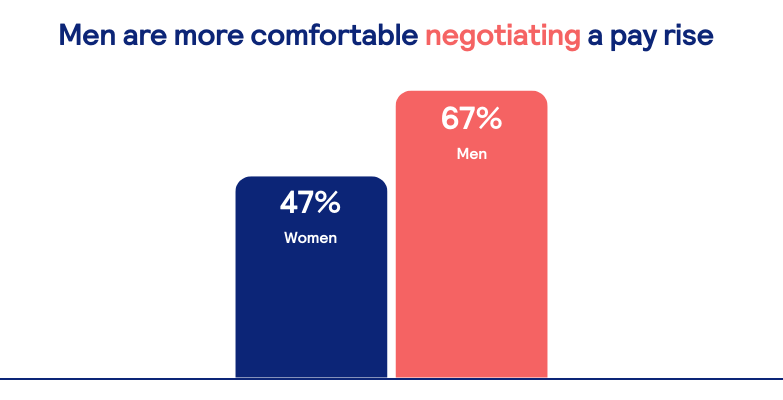
However, men in Ireland also reported higher average pay rises at 6.5%, compared to 5.4% for women. As a result, women’s salary and pay rise satisfaction are lower. Four in ten (44%) of women said their pay increase wasn’t enough to cover their current living expenses, and 44% said the raise didn’t reflect their work performance and commitment (compared to 30% of men).
When it comes negotiating, fewer women feel comfortable negotiating a pay rise and they also tend to see their market value as lower than men’s. More men (73%) than women (61%) say they are confident that their salary reflects their market value. Women’s perceived market value remains lower than men’s actual pay (€53k vs. €55k). Overall, workers believe they are underpaid by around €10k, based on what they consider fair compensation given their role, skills, and experience. As a result, women feel less satisfied with their salary compared to men.
The importance of salary transparency
Our findings show that salary transparency is set to be a vital trend in 2026 and beyond, and one that employers can’t afford to ignore.
Salary transparency is vital to appealing to talent, with candidates increasingly expecting compensation details upfront:
* 80% say a lack of salary information negatively impacts their opinion of an organisation.
* 72% avoid applying for roles with no salary information.
* 85% are more likely to apply for jobs when a salary range is listed.
From an employer perspective, 39% of recruiters say candidates drop out when salary expectations are discussed too late in the process. This can result in:
* Longer time to hire (29%)
* Increased workload for current employees (28%)
* Difficulty attracting top talent (24%)
Encouragingly, employers are starting to take action. 27% say they now consistently publish salary ranges and 29% are planning to in the near future, as 38% of job ads now including salary information.
EU Pay Transparency Directive – June 2026
This topic is particularly important for employers to take notice with the upcoming EU Pay Transparency Directive coming into effect this June. The EU Pay Transparency Directive will change how businesses set, manage, and explain pay. It aims to eliminate unjustified gender pay gaps by requiring transparency, objective, and gender-neutral pay structures. Employers will need to pay decisions that are consistent, evidence-based, and compliant.
The directive also requires employers to disclose pay ranges in job advertisements or before interviews and prohibits questions above a candidate’s pay history. Meaning, businesses must define salary bands in advance, align hiring managers on pay decisions, and equip recruitment teams to clearly explain how pay is set. The directive strengthens employee rights by
allowing employees to request pay information for comparable roles, broken down by gender. Employers must maintain accurate HR data, apply clear job evaluation frameworks, and provide objective explanations for pay differences. Any unexplained disparities may escalate into employee relations issues or legal claims.
For larger employers, the directive introduces mandatory gender pay gap reporting and requires action where gaps of 5% or more cannot be objectively justified. This directly affects governance, resourcing, and budgeting, particularly if you identify gaps late and must correct them under regulatory oversight.
Key dates for businesses:
* 7 June 2025 – Directive entered into force
* 7 June 2026 – Ireland must transpose directive into law
* From 2026 onwards – Full compliance required for Irish employers
* 2027 – Reporting obligations for bigger companies with over 150 employees
Benefits trends across 2025
With salary growth under pressure across the Irish labour market, employers are increasingly using benefits to differentiate their employee value proposition and meet evolving candidate expectations.
Rather than relying on pay alone, organisations are prioritising benefits that support long-term financial security, flexibility, well-being and career development. Key benefits gaining momentum in Ireland include:
* Enhanced pension contributions above statutory minimums: This reflects growing employee focus on long-term financial well-being and retirement planning.
* Hybrid and remote working options: This has shifted from a competitive advantage to a baseline expectation, with flexibility now a key factor in job choice and retention.
* Mental health and well-being support: This includes access to counselling, well0being programmes, and employee assistance services, as employers respond to increased awareness of burnout and work-related stress.
* Cycle to Work schemes: This continues to see strong uptake as a cost-effective benefit supporting financial savings, sustainability goals, and employee health.
* Learning, training, and development opportunities: These are increasingly viewed as critical to retention, as employees prioritise skills growth, career progression, and long-term employability.
As salary alone is not longer sufficient to attract and retain talent, employers that invest strategically in these benefits are better positioned to meet candidates expectations, strengthen engagement and remain competitive in the Irish market.
The most attractive benefits
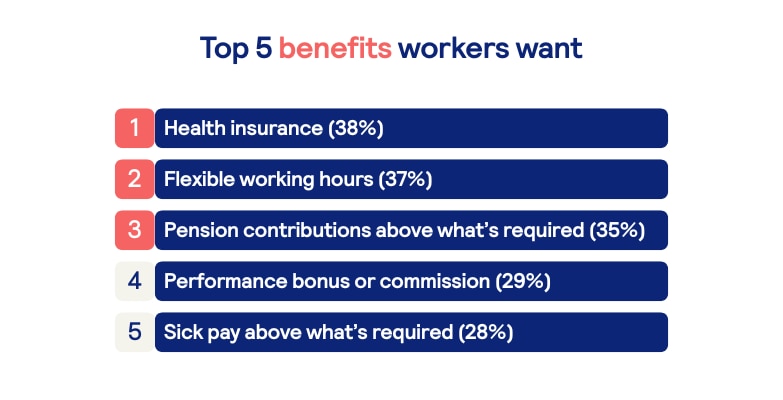
Given the emphasis employees are placing on health and long-term well-being, its unsurprising that health insurance (38%) is the most desirable benefit across the Irish workforce
Beyond talent attraction, providing this support also aids in the retention of existing staff members.
43% of workers mention that their current employer offers health insurance benefits while 32% of workers say they wouldn’t apply for a role if it didn’t offer health insurance benefits.
Benefits satisfaction
The latest research from IrishJobs shows that 73% of Irish workers are satisfied with their current benefits package.
This high level of satisfaction suggests employers are responding to worker preferences, particularly around well-being and flexibility. To maintain this trajectory moving forward, employers will need to continually evaluate their benefits packages, focusing on aligning offerings with the evolving needs of the workforce.
Industries with the highest benefit satisfaction closely mirror those with high salary satisfaction, indicating that these sectors are doing a good job of providing comprehensive compensation packages. These industries include:
1. Technology (86%)
2. Construction (83%)
3. Retail (75%)
4. Accountancy (73%)
5. Banking and Finance (73%)
When it comes to business size, 75% of large business employees are satisfied with their benefits compared to 70% of SME employees.
Tips for employers
To successfully attract and retain the talent they need in 2026 and beyond, employers will need to carefully balance shifting candidate expectations with continuing economic challenges. Even as salary remains a key driver for candidates, transparency, flexibility and targeted benefits are becoming non-negotiables.
Below we’ve outlined some of the practical steps employers can take to stay competitive in the year ahead based on the findings of our research:
* Regulatory benchmark salaries: with 72% of candidates avoiding roles without salary information and 51% of job switchers prioritising higher pay, offering competitive, clearly positioned salaries is essential. Salary benchmarking against industry and regional averages can help ensure pay remains aligned with market expectations, particularly in high-demand sectors facing skills shortages. Regular benchmarking also supports more confident salary conversations and helps reduce candidates drop-offs.
* Use pay reviews strategically: While 58% of workers received a pay rise in 2025, financial pressure remains widespread, and 44% of candidates plan to look for a new role in 2026. Regular, structured pay reviews, even where large increases aren’t possible, can help retain talent by demonstrating progression and fairness.
* Be transparent about salary: Salary transparency is no longer just a “nice-to-have”. With 85% of candidates more likely to apply when a salary range is listed, and 39% of recruiters reporting drop-offs when pay is discussed too late, publishing salary information upfront can significantly improve hiring efficiency. Transparency helps manage expectations, shortens time to hire and reduces wasted resources on misaligned applications.
* Strengthen benefits to offset salary pressure: As employers struggle to meet salary demands, benefits are increasingly important in attracting and retaining talent. Workers are prioritising flexible hours, enhanced pensions, sick pay and hybrid working, while demand for health and well0being support is rising. Reviewing and clearly promoting benefits can help employers remain competitive in the search for talent even when salary increases are limited.
* Embed flexibility where possible: Well-being support and flexibility are now a deal-breaker for workers in Ireland, while work-life balance is the top career goal for employees outside of salary in 2026. Employers that can offer health insurance, flexible hours and hybrid/remote working options are better positioned to attract a broader talent pool and retain experienced employees. Even partial flexibility can significantly improve an employer’s appeal, particularly in a market where financial uncertainty continues to influence worker behaviour.
About our research
Our data comes from OTT, an in-house job-ad analysis tool built by The Stepstone Group, which analyses job postings and associated data such as salaries, location, skills, and benefits. We analysed 1.3 million Irish job ads collected between 2019 and 2025, covering 15 industries. Salary and benefits data were extracted in November 2025 to provide a consistent view of how advertised pay and benefits have evolved over time. Using this dataset, we calculated the advertised gross median salary per industry.
Insights from a worker and employer perspective come from two Irish surveys conducted between 18 November and 26 November 2025. The worker survey captured responses from 670 Irish workers and was weighted to be representative of Ireland’s workforce by age, gender, and region. The recruiter survey gathered responses from 470 recruiters and HR professionals. Sampling and weighting were aligned with previous years to ensure comparability, with industry-level boosts applied to ensure robust representation across all sectors analysed.
Register for our Salary Strategy Bootcamp webinar 2026