
New data from IrishJobs reveals 8 in 10 of the most in-demand professionals in 2025 were in construction-related sectors, as skills shortages mount across the industry.
Findings show that Project Managers were the most sought-after professionals by employers in 2025, with demand growing 7% year-on-year (Y-o-Y). Playing a critical role in keeping projects on schedule and ensuring strong returns on investment, demand for project managers is particularly acute in the construction and IT sectors.
Accountant, Site Manager, Supervisor and Quantity Surveyor make up the top four most in-demand roles. Construction-related roles have now topped the most highly sought-after roles for three consecutive years. Demand for Accountants has increased by a significant 39% over the past 12 months, rising from seventh to second position. Supervisor in construction appears in the top 10 list for the first time.
The insights are based on an analysis of searches by recruiters in the IrishJobs TalentBank, a CV database of over 1.7 million job candidates, which enables employers and recruiters to source and connect with talent.
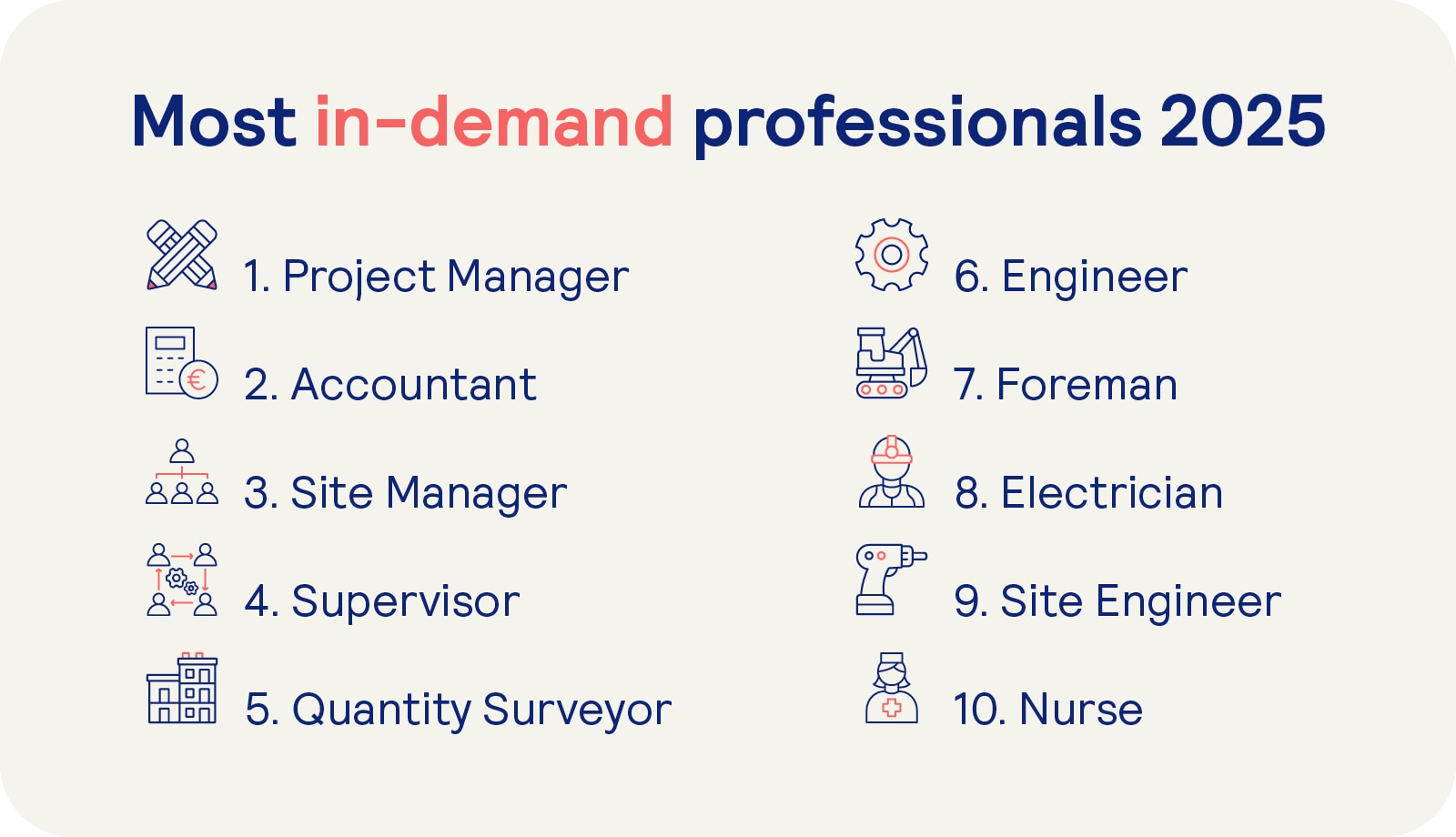
Engineer (6th), Foreman (7th), Electrician (8th) and Site Engineer (9th) all feature in the top ten most in-demand professionals. Nurse (10th) completes the top ten, falling from fifth position last year. Demand for Foreman increased by 33% while Engineer rose by a significant 26%. The rankings reflect high levels of demand for skilled professionals across the construction, skilled trades and engineering sectors to meet the growing needs of the Irish economy for housing and other critical infrastructure.
Most frequently posted
IrishJobs data on the most frequently posted job openings by employers in 2025 reveal the top jobs across different sectors of the economy. Senior software engineer is the top job in the IT sector, amid the accelerating AI transformation. Data scientist holds its position as the top job in the Science sector for the second consecutive year. Loss prevention manager is the top job in the Finance sector, Production Operator in the Manufacturing sector, and Customer Delivery Driver in the Logistics sector.
Regional trends
IrishJobs data on job openings reveals the most frequently posted jobs across major cities in Ireland. In Dublin, Customer Assistant was the most in-demand role. This was followed by Clinical Nurse Manager, Healthcare assistant and Staff nurse. Healthcare roles were also highly sought after in Cork, making up two of the top four roles: Clinical Nurse Manager (2nd) and Staff Nurse (3rd). Sales Assistant takes the top position in Cork, while Electrician is in fifth position.
In Limerick, science and pharma make up two of the top three positions, reflecting the cluster of science and pharmaceutical firms based in the country. CQV (Commissioning, Qualification, and Validation) Engineer is the most highly sought-after role, followed by Customer support representative, and QC analyst. Customer assistant takes the top spot in Galway. Clinical Nurse Manager and Sales Assistant are the second and third most in-demand roles in the county.
Insights and learnings
Commenting on the release of the findings, Christopher Paye, Country Director of The Stepstone Group Ireland with responsibility for IrishJobs, said: “Published today, new data on searches of the IrishJobs TalentBank in 2025, a database of 1.7 million CVs of job candidates across the island of Ireland, provide an important insight into key sectoral hiring trends, skills shortages, and the recruitment challenges facing Irish employers.
Despite a slight uptick in unemployment in recent months, continued, albeit slowing growth in employment is expected over the next 12 months. As employers continue to face a tight labour market, skills shortages are likely to persist across many areas of the economy in 2026.
Our findings show that 8 in 10 of most in-demand professions in Ireland in 2025 were in construction and related sectors. With construction topping the most highly sought after roles for three consecutive years now, it’s clear that this persistent skills shortage is having a major impact on the delivery of housing and critical infrastructure in Ireland.
While the Government recently announced a new infrastructure plan to accelerate the development of critical infrastructure including housing, energy and water to meet the needs of Ireland’s growing population – its success will depend on the capacity of the construction and interrelated sectors to meet their talent needs.
From sustainable development to retrofitting and modern methods of construction, the skills and capabilities needed in construction related sectors are continuously evolving. Investment in reskilling and upskilling, as well as boosting international recruitment, can help to ensure we develop an adaptable workforce fit for the future.”